The History of Pilates: Joseph Pilates and the Reformer
A patent drawing, a book of floor exercises and photographs from a dance archive tell three different parts of the Pilates story. Together they explain why a mat and a machine can belong to the same method.
A timeline of the practice
- Physical culture and internment
Born in Germany, Joseph Pilates develops an interest in gymnastics and boxing. He is interned in Britain during the First World War.
- A drawing becomes a US patent
An exercise apparatus with a moving carriage appears in German patent records. The corresponding US patent is granted in 1927.
- Joseph and Clara teach
In Manhattan, the two teach clients on apparatus and on the mat. Your Health appears in 1934.
- Contrology in print and in dance
Joseph teaches at Jacob’s Pillow. Return to Life Through Contrology presents mat work to readers in 1945.
- Teachers carry the method on
Clara and other teachers continue the work. Different teaching lineages bring mat and apparatus practice to new audiences.
- Two routes into Pilates
Mat lessons and reformer introductions offer different ways to learn how to direct and repeat a movement.
Before Pilates was a class name
In 1883, Joseph Pilates was born in Mönchengladbach, Germany. As a young man he took an interest in gymnastics, strength work and boxing. Historians place him in the world of physical culture, a movement in which people argued for the value of exercise, devised systems for teaching it and experimented with equipment. Physical culture could encompass a boxing school, an instructional book or an inventor working out how to move a platform against resistance. Pilates eventually had a hand in all three. Deutsche Biographie’s archival biography
He was living in Britain when the First World War began. As a German national he was interned, first at Lancaster and later at Knockaloe on the Isle of Man. You may hear that he built his first reformer from springs taken off hospital beds there. Researchers working with the camp’s surviving records have been unable to establish that account. The distinction matters because there is a much better trail to follow. After returning to Germany he ran a boxing school, worked on exercise apparatus and filed patents. Those records let us examine a design on its own terms. Research on the internment story
What the patent actually shows
Look at the drawing attached to US patent 1,621,477, granted on March 15, 1927. You can pick out the frame and the carriage on which the user lies. Supports help position the head and shoulders. The carriage moves along the length of the apparatus, so a person can press against a fixed support and travel backward. The arrangement turns a movement into something both teacher and student can observe. Watch the platform rather than the foot and you can still see when the person starts, stops or changes direction. Joseph Pilates’s original US patent
The machine also changed. The National Pilates Certification Program’s history describes a weight stack in an early model and later work by Joseph and his brother Fred to replace it with coiled springs. This is worth slowing down for if you have ever seen a teacher change springs between exercises. An adjustable load became one of the recognizable features of the apparatus people now call a reformer. It developed through experiments with a physical object. Even a document as precisely dated as the US patent gives a view of one stage in that work. History of the apparatus
A surviving machine adds a later chapter to the drawing. The Smithsonian holds a Universal Reformer used by Nancy Sinatra in the 1960s. A patent describes what the inventor claimed; the museum object shows that a version of the apparatus reached someone’s own exercise room. Smithsonian collection record

Putting a mat sequence on paper gave readers a way to revisit an exercise outside a studio.
A teacher beside the machine
Joseph moved to the United States in 1926. In New York, he and Clara Zeuner, known as Clara Pilates, taught the method and ran a studio on Eighth Avenue. A directory listing for the Pilates Universal Gymnasium appears in 1929. Names and dates make Joseph particularly easy to follow through the patent records. They give a less complete impression of what a person learned by attending the studio, where Clara taught, observed and worked directly with clients. National Pilates Certification Program on Clara and the studio
Imagine a person lying on a carriage for the first time. The machine can guide the direction of travel. It takes a teacher to notice that the student understood where to put a foot yet missed the instruction about how to return. Clara’s place in the story is a reminder that the method could only travel if someone knew how to teach it. Remembering the inventor alone leaves out one of the things that still matters most to a beginner: the person standing beside the equipment, watching what actually happens on the first attempt.
Contrology reaches readers on the floor
Joseph set down his ideas in Your Health in 1934. In 1945 he and William John Miller published Return to Life Through Contrology. The title preserves the name he chose for his work. The volume combines his views on exercise with photographs and instructions for a sequence of 34 mat exercises. The Hundred, the Roll Up and the One Leg Circle appear early in the sequence. These names still turn up in studios, even when a beginner meets a shorter or supported version of the movement. Published edition and exercise contents
For a reader far from New York, the book offered a striking possibility. You could place it beside you on the floor, look at the position and have a go without owning an apparatus. A photograph could show where a limb ended up, but it could not watch your movement or answer a question about the part between photographs. Modern beginner lessons, whether in person or online, solve that teaching problem in different ways. The book is valuable evidence for a historical point: mat exercises had a place in the author’s own published method long before anyone offered a streaming subscription.
Dancers leave a photographic record
The dance world took an interest in what Joseph and Clara taught. Ruth St. Denis told Ted Shawn about her experience with Joseph, and Shawn invited him to teach at Jacob’s Pillow in Massachusetts in 1941. The Pillow’s accounts describe images of Shawn and dancer Barton Mumaw exercising in the New York studio, as well as photographs of Joseph teaching at the school. Photographer John Lindquist’s exhibition includes a picture of Joe Pilates from 1943. Here we can place a particular person, working among particular dancers, in a particular decade. Jacob’s Pillow’s archive story · John Lindquist exhibition
Teaching at a summer dance school and teaching in a Manhattan studio gave the work two settings in which to circulate. A student could take exercises back to another rehearsal room. Others went much further and made a career of teaching the method. These connections help explain why Pilates remains associated with dance. They also put that association in perspective. The work reached dancers through studio clients, professional relationships and invitations. A person starting on a mat today needs none of a dancer’s training to belong there.
The people who carried the work beyond one studio
After Joseph died in 1967, Clara continued teaching. The New York studio remained open, and Romana Kryzanowska took on a leadership role. Students including Eve Gentry, Ron Fletcher and Kathleen Stanford Grant had their own teaching careers. Gentry brought her work to New Mexico; Fletcher taught in California. Grant worked with dancers at New York University’s Tisch School of the Arts. When people speak of lineages in Pilates, they are often tracing relationships like these: who learned from whom and where that person went on to teach. Pilates teaching history · University of Maryland research on Grant
A family of teachers can agree on the importance of a controlled return and still teach that return in different ways. One may keep an established order of exercises, while another may break a movement into smaller preparations. If a listing says classical or contemporary, ask the teacher how someone new will be introduced to the sequence. The answer will tell you more about your first hour than a claim about who has the longest line back to Joseph.
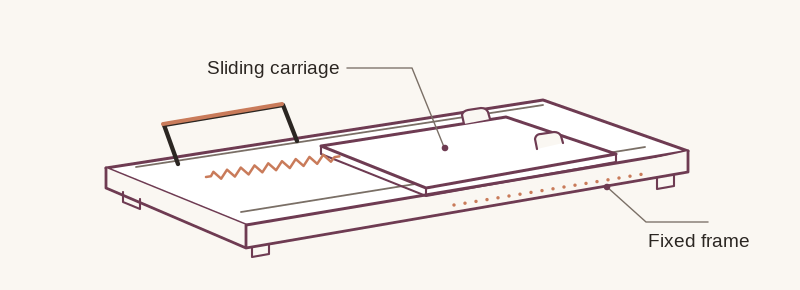
The frame stays still while the carriage moves along the rails against springs.
Mat and reformer are two ways to ask a movement question
On the mat, try imagining the One Leg Circle from the book. The floor stays still. The person directs the leg around a path and controls how much the rest of the body moves. A teacher can vary that task by making the circle smaller or changing how the other leg is supported. On a reformer, the carriage itself can move, and a spring can resist part of the motion or assist the return. Guiding it home takes attention even when the spring is pulling it in the direction you want. How mat and reformer classes differ
If your curiosity is about repeating a movement until a cue makes sense, a mat lesson is a good place to try it. If you want to feel how changing the equipment changes the task, choose an introduction that teaches the machine. For home mat practice, check what makes a mat suitable before assuming you need any other equipment. If you want more guidance about the way you sit and stand, see Pilates and yoga for posture. For a broader choice between the two practices, take the Pilates or yoga quiz to choose a first step based on how you like to learn.
Common questions
What did Joseph Pilates call his method?
He used the name Contrology. His 1945 book with William John Miller, Return to Life Through Contrology, sets out ideas about practice and a sequence of mat exercises.
Was the first reformer a hospital bed?
Joseph Pilates was interned during the First World War. The often-repeated camp bed-spring story lacks firm contemporary documentation. The German patent record and US patent drawing provide firmer evidence about his apparatus.
Did Joseph Pilates work alone?
Clara Zeuner, known as Clara Pilates, taught the method and helped run the studio. Students later became teachers and brought the work to dance schools, other cities and new generations.
Is mat Pilates a modern substitute for the reformer?
Mat work belongs to the published method itself. The reformer offers a moving surface and adjustable resistance; the mat offers a stationary surface on which the practitioner controls the movement.